MUSICTEACHERS.CO.UK VOLUME 2 ISSUE 3, SEPTEMBER 2000  
Online Journal
CAREER PROFILE:
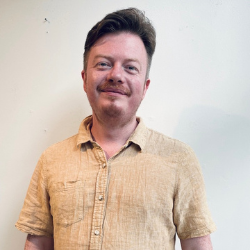
Andrew Benians

Pianist, organist and Lay Vicar at Chichester Cathedral, Andrew Benians has had a varied and interesting career that started as a boy in the 1960s. He has been at Chichester for the past sixteen years and took time out of his busy schedule to talk to MT.co.uk.
 

  Where and when did your musical interests begin?
 

My uncle, who was a member of the Salvation Army, realised that when I sang, it was perfectly in tune. He told my mother and she asked if I would like to learn the piano. I was about six or seven at that time and I started having lessons, which were quite successful. Also, at about this time, we had a violin at home, so I started having lessons on that as well. To begin with, these were also successful, but it soon became clear that my interests lay with the piano.

When I was eight, in 1969, I had a voice trial at St Paul's Cathedral, London, and I was successful! I couldn't believe it and this was to be my home for the next five years. Apart from on Thursdays, I had to sing services each weekday, as well as two on a Saturday and three on a Sunday. It was a hard life for a chorister: we were boarders and had to get up at seven o'clock in the morning. We all had to learn the piano and another instrument, and by seven-fifteen, we had to be diligently practising. At about ten to eight, there was a morning service in the school's chapel, and only then were we allowed breakfast. Choir practice came about half an hour later, after which we had to start school! This happened every day during term time and we only saw our families for holidays.


  Who influenced you and why?
  To begin with, my choirmaster, Christopher Dearnley was a big influence - his manner of conducting, the way he explained music and the way he got us to sing musically were excellent. Other important influences came much later - Kenneth Ryder, who was (and still is), organist at St Peter Mancroft in Norwich, Ruth Harte, who taught me piano at the Royal Academy of Music and Douglas Hawkeridge, my organ tutor there, were all important teachers. But perhaps the biggest influence in terms of musical artistry was John Scott, the present organist at St Paul's. He transformed my playing completely.

  What do you think shaped your musical tastes?
  Obviously, my teachers were important, but the Academy was important in terms of non-classical influences - listening to Bill Bruford at two o'clock in the morning, but I also enjoyed listening to The Who, Genesis, The Electric Light Orchestra, Focus and Pink Floyd - basically, all the big names in rock of the 1970s. In fact, I often wonder why I ended up being a classical musician!

  Had you always planned a career in music?
  Yes, because I was always useless at other subjects. I don't think I actually planned a career in music - it just seemed natural that this was the road I should I should go down. Since then, I have been very busy as a singer, accompanist and recitalist - it's been very hard work and the recompense is not always that good, but how many people can do a job they really love? I can.

  What do you feel is the most exciting aspect of your professional life?
  Although I spend a good portion of my time teaching, which is satisfying, I still prefer to perform. I give several organ recitals a year, but most of my work is as an accompanist, which although being a difficult skill, is one that I find quite easy - I think that because I am a singer, so I have a natural affinity for accompanying.

  What are the major challenges facing you now as a professional musician?
  It is always hard to keep your standards up professionally, especially when you spend so much of your time teaching. However, I practise diligently as often as I can, but always do at least fifteen minutes technical exercises every morning just to keep my fingers in shape. I am a countertenor, and for these the early forties are usually a turning point. I am having to re-work my voice, with the excellent help of James Bowman, and am developing my bass voice more. Oddly, this is helping my countertenor in a big way.


Problems? Comments? Suggestions? Contact Us.
Site coded by passive.
Copyright © Bridgewater Multimedia 2001.