|
|||||||||||
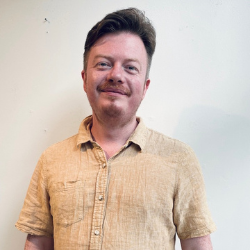
You are known as a pianist who specialises in contemporary music. Is that how you see yourself? Not really. Although I have performed Vingt regards several times now, I don’t actually regard Messiaen as a modern composer; Kapustin’s piano works, which I recorded for Hyperion (CDA 67159, reviewed in MT.co. uk’s Online Journal, August 2000) are jazz-based and cover a variety of styles, but they were written some years ago and, since I’m just as at home playing Beethoven or Bach, I don’t think I can be pigeon-holed quite as easily as that. You are known also for performing jazz improvisations in many of your concerts. Would you say that these are particularly individual or do you follow a particular style? I listened to a lot of jazz when I was at college and I developed quite a feeling for it. Although I admire performers like Art Tatum enormously, I find that playing their music is a bit like watching a Charlie Chaplin film…I can’t quite see the relevance of that style for today’s musician. In particular, I like the modern jazz school composers such as Keith Jarrett and Miles Davis, and, like them, I try not to fall into playing a collection of clichés. Sometimes, I make a self-conscious attempt to borrow elements of classical structure in my jazz playing, for example working with very limited motivic material. I also like to take a single element and alter it to produce a range of different structures and effects. I might, for example, improvise on a stride bass by playing it on the off beats, or alter its rhythm so that I get patterns of threes against fours. Do you think your strict musical training has helped you to develop a personal approach to jazz? In some ways it has – classically trained musicians are bound to play jazz very differently. In terms of control of sound alone, there are so many different ways of approaching the keyboard which jazz musicians don’t always use – physically, their approach is much more angular, with such elements as legato generally becoming less important. A jazz musician might, for example, severely accent a note in the middle of a phrase for the rhythmic feel and that is one of the hardest tasks for a classical player to do; for them, rhythm is often less interesting and more one-dimensional. They don’t inhabit the rhythm with the same ‘intensity’ as a really good jazz player, who is so incredibly focussed on tiny nuances, and how these are stretched to be, for example, placed slightly behind a point or pushed slightly ahead, all within the context of an absolutely regular beat. I sometimes feel that, by comparison, the sense of rhythm in classical performances is quite boring. Does this have a bearing on your performance of jazz-based works, such as the Kapustin pieces you recorded last year? It is very hard to get this kind of feeling playing notated music; it only seems to work when I improvise. Playing from a written score makes it very difficult to get a sense of spontaneity, something that is much easier to attain when you are improvising. When I improvise, if something works one night, I can be sure that if I try to do the same thing on another, it will never be as successful; not knowing what’s going to come next is an essential part of it – it’s a feeling of discovery. |
|||||||||||
|
Problems? Comments? Suggestions? Contact Us.
Site coded by passive. Copyright © Bridgewater Multimedia 2001. |
|||||||||||