|
STARTING OUT
A new series in which we find out about young musicians and college
leavers, and ask them to discuss their hopes and aspirations for their careers.
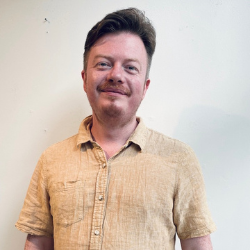
This month we meet 22-year-old Mark Allen, a trumpeter in his final
postgraduate year at the Royal Northern College
of Music in Manchester, England.
|
|
 |
|
Tell us something of
your background, in particular how you came to be a musician. |
 |
|
My mother, who plays the
violin and the piano, was keen to go to music college, but in those days things
weren't so easy and a lack of available money put paid to her aspirations, so I
think she was very pleased when my older brother started to play the trumpet. I
went to the same school, King Edward's
School, Bath, at about the age of eight, where I also began trumpet
lessons. A couple of years later, I started piano lessons as well with a
brilliant teacher called Edna Blackwell. I must have been quite successful in
the early stages since I soon caught up with my brother. I was very keen for
people to see that I was progressing nicely, if not that I was doing much
better than my brother – I was a little cocky then – and played in just about
any band I could. However, I never thought about doing music seriously as a
career, because the general atmosphere of my school placed a lot of value on
the number of pupils it sent to study 'serious' subjects at Oxbridge, something
I certainly thought they had in mind for me.
But, at the age of about fifteen, I became a member of The National Youth Orchestra, where I met
lots of people who were going on to music college. That was definitely a
turning point in my life, because I was provided with many high-quality
experiences from the top-class tutors and conductors to the people I was
working alongside. So, despite enjoying sciences (I was doing maths and physics
at A-level as well as music), I couldn't see myself studying them for three
years, so I decided that I would give music a go. |
 |
|
What would you have
done if you hadn't decided to study music? |
 |
|
I haven't a clue…I might
have gone somewhere and done something with sciences, but because I couldn't
really think of anything other than music, it seemed the most logical thing to
do. |
 |
|
What made you choose Manchester as
a place to study? |
 |
|
I didn't come to Manchester purely
because of the RNCM; I wanted to do the joint course with the University
because I thought I would benefit from an academic degree course. But I
wouldn't have gone to a music college alone, partly because of my parents' and
school's wishes and partly because of what I thought I needed. It was only when
I was half way through my first year that that I wasn't quite living up to the
expectations of the joint course. I was beginning to succeed with my playing,
and was so busy doing other things that my university studies had to take
second place. I didn't plan for it to turn out that way…but I'm glad it
did! |
 |
|
What do you think you
got out of music college? |
 |
|
A lot of playing and a
lot of contacts, but most of all, some fantastic teachers, such as John
MacMurray, who must be one of the biggest influences in my playing. He showed
me that, to succeed in music, you have to be a musician rather than someone who
just plays the notes. I didn't play in the orchestra that often because in my
first couple of years the university took up so much of my time. I also formed
a brass group, Zeneka, which came second in the Association of European
Conservatories Brass Quintet competition in Paris and which won the Sir Malcolm
Arnold Prize at the RNCM. |
 |
|
Do you see yourself as
an ensemble musician or a soloist? |
 |
|
If I had been asked that
question two years ago, I would have said both, but then John MacMurray gave me
my first professional work with the Hallé
Orchestra and since then I've been too busy to worry about being anything
other than an orchestral player. That doesn't mean that solo work is something
I don't want to do, which is why I enter both orchestral and solo competitions,
such as the one I'm entering at the end of May during the International Trumpet
Guild's conference in Indiana. |
 |
|
Your postgraduate year
has been quite important in shaping your career ideas. Would you like to say
something about that? |
 |
|
Previously I had done
occasional gigs with the Hallé, Manchester Camerata and
elsewhere, but this year things have developed considerably; in July 2000,
however, I was approached to become Guest Associate Principal Trumpet with the
BBC Philharmonic Orchestra which I was more than keen to do. It was extremely
hard work, fitting in both the BBC and college, but it was hugely rewarding: I
was playing every day alongside fantastic players, with brilliant conductors
doing very challenging repertoire. And that has made me think that people want
to listen to me and, not only am I capable of playing in a top-notch orchestra,
but that I really want to. |
 |
|
Have you seen the last
five years as being a success? |
 |
|
Absolutely! I've found
out what I want to do, where I want to go and I'm using every available
opportunity, looking ahead to whatever comes next. Musically, it's been a huge
success and has set the ball rolling…my teacher says "there is always room for
another musician in the profession". There might always be someone around who
can play higher, faster and louder than me, but I am learning more and more
about how to be a musician and that is what I constantly strive towards. |
 |
|
Where do you see
yourself in ten years time? |
 |
|
I'd like to have a
principal's job in a great orchestra, preferably in this country, but still
having time to do the occasional solo gig. I've still got a lot of work to do
and I realise that I'm going to have to keep my feet firmly on the ground, but
there will be many opportunities…and I'm going to make sure that I don't miss
any of them! |
|